
Box of Tricks
The difficulty of refereeing a crowded penalty area combined with the way VAR is used leads to inconsistent decision-making. Is there a better way?

Tl;dr:
Given all the contact in packed penalty areas, refs have a nigh-on-impossible job.
The Premier League and PGMOL have issued useful guidelines on what is and what isn’t a foul in these situations.
These guidelines should be used to inform discussions about potential offences in the box.
Yet, while such instructions are helpful for referees, their task remains very challenging.
Rather than the on-field official trying to identify fouls in the box in real time, there could be a greater role for VAR.
But this could well lead to more VAR interventions, and so goal celebrations would become even more conditional.
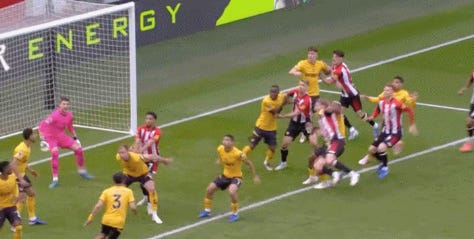
Accurately refereeing a crowded penalty box is an almost impossible task. There’s so much pushing, pulling, holding, grappling, and blocking that an official cannot hope to spot every incident, let alone carefully evaluate each one.
In part, football’s relevant laws are blunt, for example stating that it’s an offence if a player “holds an opponent”. The reality of what goes on in the penalty area dictates that the application is far more nuanced.
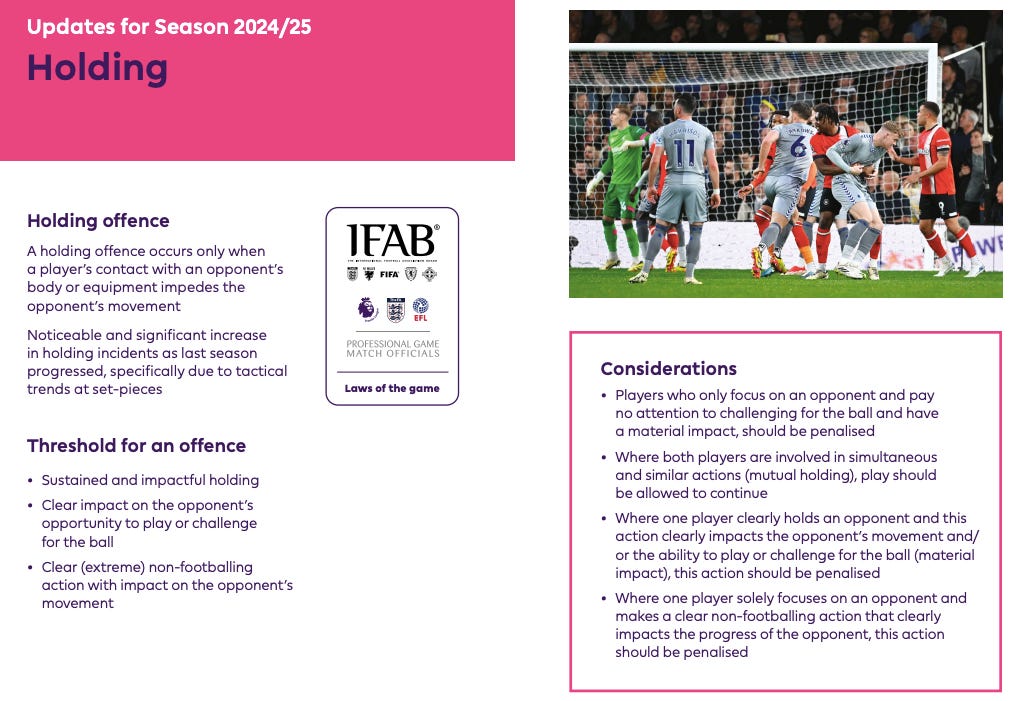
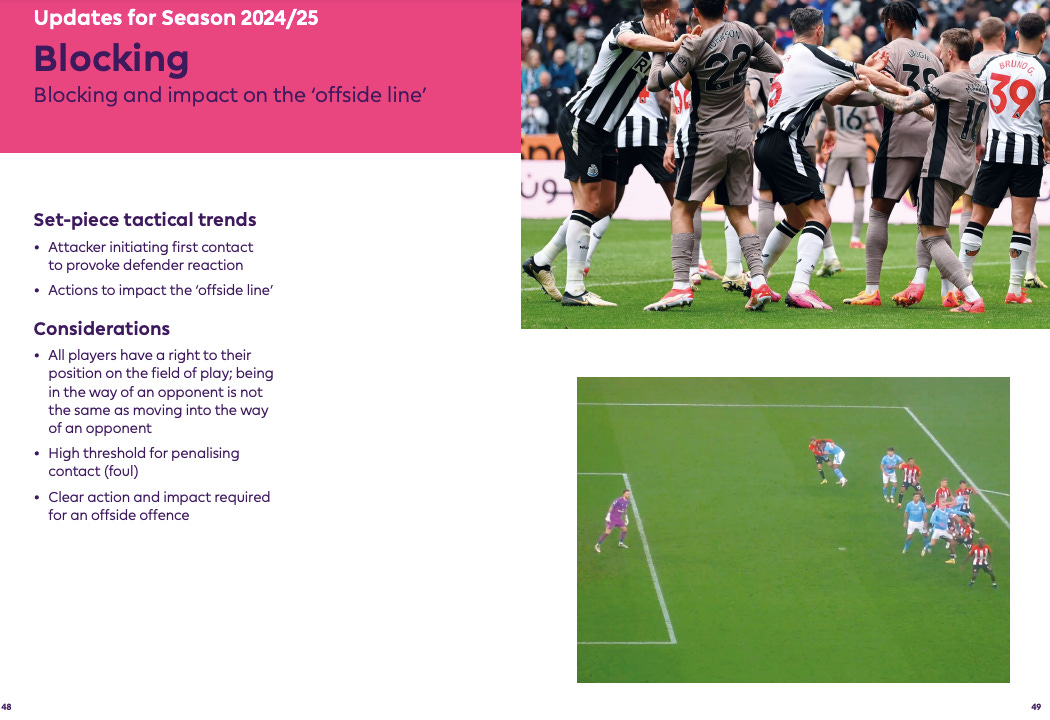
To their credit, the Premier League and Professional Game Match Officials Limited (PGMOL, a company funded by the Premier League, FA, and Football League to provide referees) attempted to clarify decision-making in this area by issuing some useful guidelines in their handbook for this season:

High Bar
These guidelines aren’t comprehensive and they don’t eliminate subjectivity (e.g., the precise meaning of “sustained” holding has been a subject of debate), but they do help clarify what’s considered a penalty-worthy offence, and thus also set a relatively high threshold for a foul by an attacker.
This is the sort of approach referees generally take, and it means there aren’t that many penalties given or goals disallowed due to offences that occur pretty much every time a dead ball is delivered into the box. It would help if these guidelines were routinely used to inform discussions about potential offences in a crowded box.
(As an aside, it would also help the broader conversation around refereeing if all professional and amateur commentators took away one obvious conclusion from this issue: Not all ‘fouls’ in the penalty area warrant a penalty; though it’s not stated in the Laws of the Game, referees typically apply a higher bar for penalties than for free kicks.)
A Soft Touch
Yet, even with helpful guidelines in place, refereeing a crowded box is still an incredibly difficult task, and mistakes inevitably occur.
A recent example came not in a PGMOL-officiated match but during the 23 January Europa League tie between Rangers and Manchester United. Referee Erik Lambrechts disallowed a potential United goal by Matthijs de Ligt due to contact by Leny Yoro on Robin Propper as a corner was delivered. You can watch it here.
On TNT Sports, Rio Ferdinand called it the way most of us would: “I'm not having that. That is so soft, he has just touched him, he has leaned on him slightly.” United went on to win the game, so any further outcry was relatively muted.
This is the type of decision that’s often given against an attacker in a different context that will be familiar to most fans: a defender shields the ball in their own third, an over-eager attacker makes a slightly clumsy challenge, the defender goes down on minimal contact. In such cases, referees often side with the defender; defenders know this, and often play for these ‘soft’ free kicks to get out of an awkward spot.
Protocol Matters
These types of decisions aren’t normally given in a crowded box, partly because there’s so much contact taking place. At Old Trafford, Lambrechts may have misjudged the incident, believing the contact to be more forceful than it was, or perhaps he thought Yoro deliberately tripped Propper.
Such possibilities open the door to VAR—yet no intervention occurred.
I’m unsure of exactly how UEFA interprets the VAR protocol issued by the International Football Association Board (IFAB), the body that governs football’s laws, but it may take pretty much the same approach as PGMOL: In England, if VAR confirms that the contact penalised by the referee occurred, then it also confirms the on-field decision, even in cases like this one where the contact wasn’t heavy enough to warrant a penalty.
Addressing Inconsistency
The difficulties on-field officials face in refereeing a crowded box combined with the way VAR is being applied breeds inconsistency, something we’d all like to minimise.
So, what to do?
In theory, a zero-tolerance approach could be taken and all holding, blocking, etc, would be penalised, however slight.
Though this would be a dramatic shift—and players would keep seeking marginal gains by pushing up against whatever guidelines replaced existing ones—it shouldn’t be dismissed outright.
Offside Example
An alternative could be dealing with potential fouls in the box in roughly the same way PGMOL handles offsides: To try and avoid denying valid goals through errors, if they’ve any doubt, assistant referees wait until an attack has played out before flagging.
Similarly, after observing a melee in the box, referees could wait to see if a goal is scored or for the ball to be cleared before blowing for a foul against the attacking team or for a penalty. VAR would then get involved, and be given more scope to recommend the referee review their decision. VAR could also be encouraged to intervene if the referee missed an offence.
There would be objections in principle to this, as it means VAR encroaching further into the on-field referee’s territory—but then this is an obvious area where the on-field referees require assistance because of just how challenging their task is. (In theory, assistant referees could help spot penalty area offences, but they need to stay on the touchline to make offside calls and so are not well-positioned.)
Trade-Offs
Greater VAR involvement would, of course, by no means be a perfect solution. It would probably lead to more penalties and cancelled goals, which some would object to and others be more relaxed about.
It would place more emphasis on the laws and any accompanying guidelines, strengthening the case for defining terms like “sustained” holding. This could lead to better rules and greater understanding of how the game is refereed, desirable outcomes.
As with most tricky officiating issues, there would be clear trade-offs. The primary one here is that while empowering VAR more should eliminate outlier decisions like Lambrechts’, delays would increase as longer checks occur more regularly, and fans’ celebrations of set–piece goals would be increasingly conditional in the knowledge that VAR has been given more license to chalk them off.