
Oliver’s Twist
An almost unsupportable call.

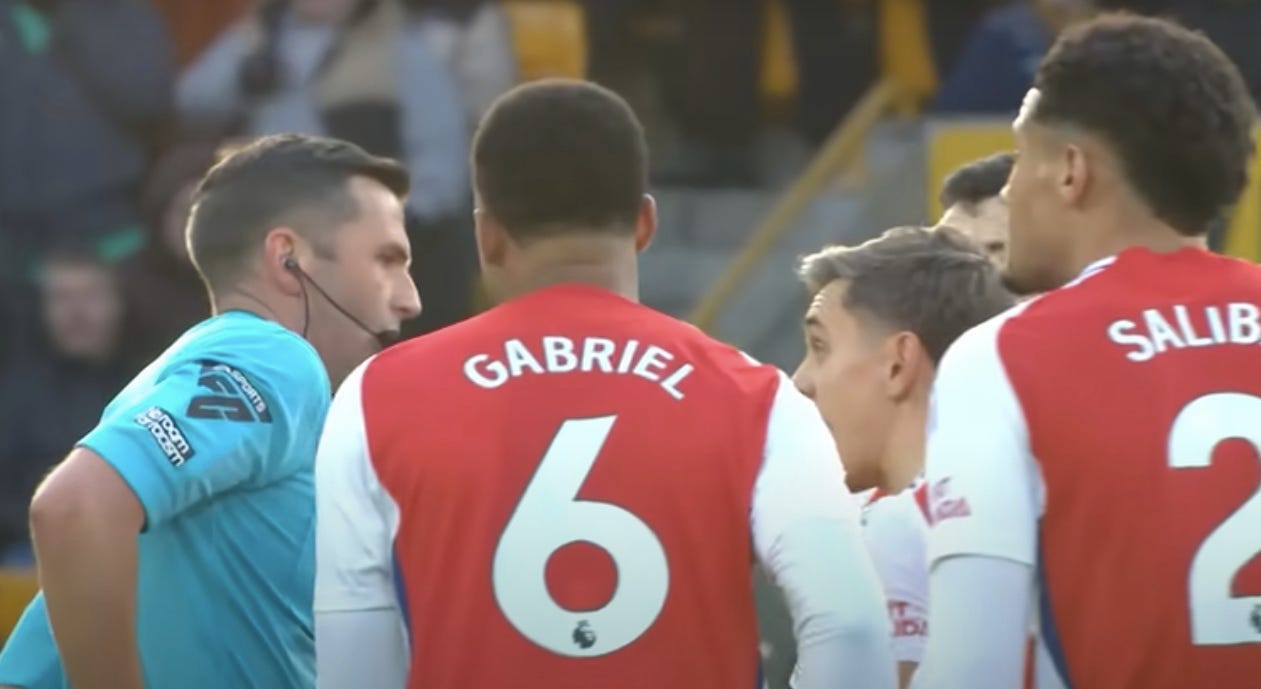
The Premier League refereeing body, the PGMOL, entered probably its biggest controversy of the season when top official Michael Oliver issued a straight red to Arsenal’s Myles Lewis-Skelly in a 25 January match against Wolves. VAR went with the Referee’s Call. So far, few journalists and pundits have backed the officials.
The controversy is because Lewis-Skelly was sent off for a challenge that when watched live looked for all the world like it would lead to a yellow card.
By deliberately upending Wolves defender Matt Doherty to stop a counterattack, he committed a ‘professional’ or ‘tactical’ foul; what is known in the refereeing trade as Stopping a Promising Attack (SPA). While you can argue that such cynical action should be punished with a sending off, the laws say an SPA offence should be punished with a caution.
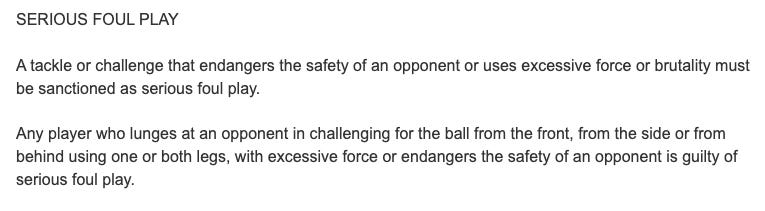
Instead the justification Oliver reportedly provided for the red was that it was “Serious Foul Play” because Lewis-Skelly made contact with his studs on the “side of the shin then down onto the ankle”. Serious Foul Play is defined in the Laws of the Game as:
Full and forceful?
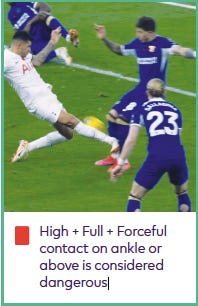
This season’s Premier League and PGMOL guidelines for serious foul play state that “High + Full + Forceful contact on ankle or above is considered dangerous”.
It’s reasonable to say that Lewis-Skelly lunged from the side, and he made contact above the ankle. Yet I think a large majority of observers would say that he didn’t use “excessive force”, or that the contact was not “forceful” and “full”.
Oliver’s position seems to be that Lewis-Skelly “endangers the safety” of Doherty, who was moving at speed. Yet this type of deliberate trip on an opponent running fast occurs fairly regularly, and results in a caution.
It’s highly debatable whether the challenge particularly endangered Doherty. Any studs contact on the ankle was light as Lewis-Skelly stretched and his boot flicked upwards before coming down on Doherty’s foot. Yet there was no forceful stamping motion and little body weight behind the challenge to make it especially dangerous.
That seems to be the sort of view held by former top referee Dermot Gallagher. He told Ref Watch on Sky Sports today that Miles-Skelly very cynically “flicks out” to break up a promising attack, but does so without the “brutality” or “malice” to warrant a red card.
Clear and obvious?
For many, as often, a perplexing aspect was that the VAR, Darren England, didn’t recommend that Oliver review his decision. Instead, England swiftly determined it was indeed a case of Serious Foul Play, validating the call.
We shouldn’t, however, be at all surprised by this— as discussed before, this accords with the way VAR protocols are reportedly interpreted by PGMOL. Although the VAR may possibly have thought Oliver’s interpretation was harsh, the type of contact that Oliver described did occur. We are told that VAR currently doesn’t recommend a review if the on-field referee’s observation of contact is confirmed in replays.
Of course, many, including Gary Lineker on Match of the Day, think VAR should intervene in such cases. Manchester United YouTuber Mark Goldbridge argued it was a "clear and obvious error", so meeting IFAB’s threshold for VAR intervention.
While that case can be made, it doesn’t fit PGMOL’s current interpretation of the IFAB VAR protocol.
Appealing precedent
The indications so far are that PGMOL is not just reminding everyone of how VAR is used, but that it’s standing by Oliver’s call. Arsenal will surely appeal today, which would leave the matter in the hands of the FA’s review panel.
Interestingly, the previous times the panel upheld appeals in the Premier League this season were for somewhat similar incidents, albeit neither Brentford’s Christian Nørgaard nor Manchester United’s Bruno Fernandes caught an opponent high due to a deliberate SPA.
In his review of the 29 September Fernandes incident, Dale Johnson, a VAR expert at ESPN, wrote “...it became clear that Fernandes had not led with, or made any contact with his studs, and there was low force. It was a glancing blow with the outside of his boot.”
It’s easy to imagine a similar explanation being provided as to why Lewis-Skelly should have only been cautioned, though that isn’t to say the contact was the same in the two incidents.
Regardless, there’s an opportunity here for PGMOL or the FA panel to say that Oliver erred, and that actually, while high, the contact was not sufficiently “full” and “forceful” to be considered endangering and so Serious Foul Play according to the PGMOL guidelines.
Potential tweaks
If they stick by Oliver’s interpretation, it would raise a question about how serious foul play is being judged by PGMOL, particularly given the challenge by Wolves’s João Gomes in the same game. To many, that looks more dangerous, as he stamps down with some force on Jurrien Timber’s foot.
The officials’ explanation appears to be that it did not involve contact above the ankle. Such guidelines help referees make decisions, but this would arguably expose a flaw in them—it seems an assessment of the relative danger of Gomes’s and Miles-Skelly’s fouls should not be so based on the height of the challenge.
Incidents like Lewis-Skelly’s tackle may well up the pressure to increase the scope for VAR interventions, which would come via PGMOL tweaking its interpretation of IFAB’s VAR threshold. There are many considerations here, but broadly PGMOL could look to cricket for inspiration where umpires’ incorrect calls are often overturned using technology, without undermining their authority.
Mistakes by referees are inevitable in football given the enormous challenges officials face, and technology could, in theory, be embraced more in order to try and assist them with their very difficult task.
I know that PGMOL have a Head of Community and Public Engagement in Chris Foy. But I’d like to see PGMOL engaging the public more on the philosophy and ethics of respecting refs. To me, it seems fans are simply told to respect refs (as they should). But it’s the philosophy of sport that makes it interesting. And it’s the philosophy of respecting referees (e.g. stoic acceptance of what you can’t control, graceful acceptance of human and technological limitations) that makes sport more dignified and beautiful.
There would probably be a lot more jeering from fans against the refs if more of their decisions were overturned with the help of technology, but they would just have to develop a thicker skin (they must already have quite a thick skin, if they're willing to enter the profession). I wonder whether the chanting by Arsenal fans against Oliver in an earlier game (when they sang "It's all about you") riled him and (whether consciously or not) influenced his decision-making. That said, there are stats suggesting his apparent anti-Arsenal bias goes back quite a way (he's shown 7 red cards to Arsenal players in 54 games, and only 1 to a Liverpool player in 56 games).